Mentoring continues to be an important employee engagement strategy for 2025.
Key mentorship statistics—including our exclusive insights on Fortune 500 mentoring programs—help explain why mentoring is a must-watch trend. We have also included industry-wide statistics on mentoring across related areas, such as trends on Millennial and Gen Z workers, DEI, and employee development and retention.
We add new mentoring stats regularly and replace those outdated to give your data references a stronger impact on your intended audience, we recommend bookmarking this page for future research.
Mentorship Statistics from Fortune 500 Companies
Effective, high-quality mentoring stats and data now play a central role in every industry, especially talent management. Business leaders rely on strong data for every major decision, including the running cost/benefit analyses on existing engagement strategies or as they explore the potential ROI of creating new ones. That includes whether or not to launch or expand mentoring programs.
In 2009, news agencies and company blogs reported that “70% of Fortune 500 companies use mentoring programs.” That number has jumped since then. In our inaugural 2021 Mentoring Impact Report, we discovered that 84% of Fortune 500. Since then, our annual reports have found that those numbers jumped to 92%, and as of the beginning of 2024, rose up even higher. Overall:
- 98% of ALL US Fortune 500 companies have mentoring programs
- 100% of the TOP 50 US Fortune 500 US Fortune companies have mentoring programs
- The median profits for Fortune 500 companies with mentoring programs were OVER 2X HIGHER than for those without mentoring programs
- Fortune 500 companies with mentoring programs were significantly more resilient against employee quitting trends that reigned in 2021, with a median YoY employee growth of just over 3%. Meanwhile, Fortune 500 companies without mentoring programs had a MEDIAN DECREASE of 33% in their number of employees

Employee Productivity Stats: A Problem for Businesses That RTO Won’t Fix
Throughout 2023 and into 2024, companies have struggled with low employee engagement, low productivity rates, and general discontent among workers. This trend is colloquially called “The Great Gloom.” A large number of companies are trying to solve the productivity issue by mandating a return-to-office, or RTO. Data shows that this is not working as intended:
- Between 2022 and 2023, the number of website pages mentioning “employee productivity” jumped 120%. (Google Search Results)
- Average hours worked have dropped progressively since 2019 when U.S. employees reported working an average of 44.1 hours. In 2024, they work 42.9 hours per week. (Gallup)
- Employee engagement in the U.S. fell to its lowest level in a decade in 2024, with only 31% of employees engaged. (Gallup)
- Lost productivity costs the world economy an estimated $438 billion. (Gallup)
- 90% of companies plan to bring people back to the office to solve the productivity crisis. (Resume Builder)
- 64% of CEOs believe there will be a full return to office by 2026. (KPMG)
- 87% of CEOs plan to incentivize employees to return in person by offering the best assignments, promotions and raises to those who do. (KPMG).
Many executives are pulling people back into the office because they believe two things: A) It’s what employees want and B) It will improve productivity. They’re likely misguided, as the data shows.
- A 2024 study found that return-to-office (RTO) policies did not impact employee productivity or company performance. (Business Insider)
- During the pandemic, productivity increased in the U.S. states with the highest levels of remote work. (BLS)
- That same study found that RTO policies reduced employee job satisfaction and led to a decline in companies’ Glass Door ratings.
- Although 77% of executives believe a strong company culture is a benefit of being on-site, only 39% of men and 34% of women agree. (McKinsey & Company)
- 97% of employees believe fully remote or hybrid work is their preferred working arrangement (FlexJobs)
- 56% of people know someone who will quit if they’re forced back into the office. (FlexJobs)
- Several economists found that remote work not only lowers labor costs, but many employees would sacrifice higher salaries for remote work flexibility. (Barerro, Bloom, et. al)
To sum that up:
- Employee productivity, job satisfaction, and happiness are all down.
- Executives believe pulling people back into the office is the answer.
- Data shows employees that not only do employees disagree with this approach, it could actually decrease productivity even further and result in higher employee turnover rates.
That begs the question: What is the answer to lower employee productivity rates? There are many, but employee engagement, development, and connection through mentoring has emerged as a strategy that consistently works.
Read our 2024 Mentoring Trend on the impact of mentoring on productivity to learn more about why.
Research shows that having a mentor can have a significant impact on both the mentee and the organization. According to a CNBC/SurveyMonkey study, 89% of employees with mentors say their colleagues value their work, compared to just 75% of those without mentors. If you’re considering mentoring to improve your career prospects or help your organization develop its talent, these statistics suggest it could be a valuable investment for engagement, retention, and productivity.
How does mentoring improve employee productivity and engagement?
The impact that mentoring has on employee engagement and productivity lies in its distinct impact on skill development, employee connection, and job satisfaction.
Mentoring is no longer a “nice to have.” It’s essential for businesses to successfully meet critical performance objectives in a way that solves the productivity, engagement, and job satisfaction crisis.
If the Great Resignation taught us anything, it’s that workers with in-demand skills are willing to walk away from their current employer if it means finding a job that offers a better quality of life, better work-life balance, more upskilling and reskilling opportunities, and deeper and more meaningful workplace connections and interactions.
- Nearly 50% of people (or more) were looking for a new job in 2021. That continued in 2022 and is likely to continue into 2023. (Gallup)
- Workers at practically every level (individual contributor, manager, senior manager, and vice president) are significantly less likely to consider quitting if they have a mentor. (CNBC/SurveyMonkey)
- 94% of workers would stay longer and their employer offered more learning and career development opportunities. (LinkedIn)
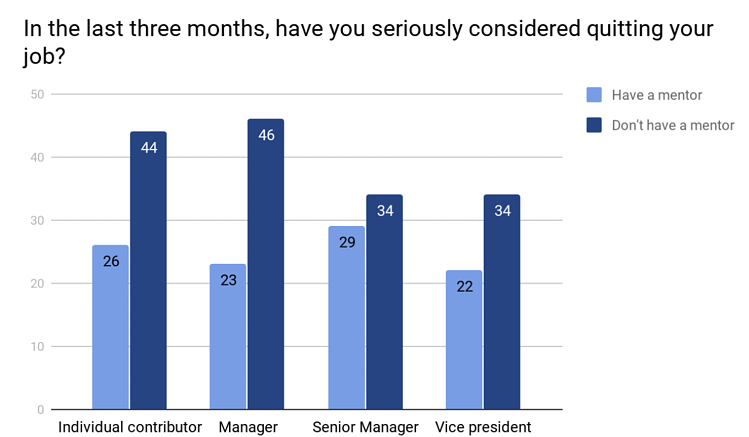
- 90% of workers who have a mentor report being happy in their job. (CNBC/Survey Monkey)
- Employees who are involved in mentoring programs have a 50% higher retention rate than those not involved in mentoring and 93% of mentees believe their mentoring relationship was useful. (MentorcliQ)
Mentorship Statistics Explaining Why Companies Offer Mentoring
- In its 2023 L&D Global Sentiment Survey, LPI discovered upskilling and reskilling was #1 on its list of strategies L&D teams were looking at. (LPI)
- In that same survey, collaborative/social learning and mentoring/coaching both remained in the top 10 from the previous year. (LPI)
- The pandemic caused a 30% increase in mentoring initiatives at organizations (LHH)
- Between 56% to 71% of organizations (or more) now use mentoring to some degree (DDI, LHH)
- 69% of companies report having a significant skills gap. (Wiley)
- Yet only 26% of employees would rate their company’s mentoring programs with an 8 out of 10 or better. (HR.com)
- 40% of companies are using now leveraging technology to improve the impact mentoring and coaching programs in a remote and virtual setting. (HR.com)
Long story short: Workers are growing anxious. The pandemic caused a fundamental shift in how people view their relationship to work. People are reassessing the meaning of work itself, tying it into their greater meaning as it regards what they want out of life, and effectively voting with their feet. Companies are now catching on to the wide employee retention and engagement issues that mentoring can solve.
We’ve highlighted more examples of mentoring facts and stats below to help paint the picture even further.
Mentorship Stats on Career and Skill Development
Particularly in light of the Great Resignation, workers want the opportunity to grow and learn. In fact, over 66% of workers are willing to retrain and reskill for new jobs. However, the desire to learn alone through digital courses is waning. Many people prefer not to simply learn alone from digital courses but through 1-to-1 or 1-to-many mentoring relationships.
Quick stats on the need for upskilling, reskilling, and development
- 34% say a lack of mentorship has held them back in their careers. (University of Phoenix)
- 56% of American workers say they do not have a mentor. (University of Phoenix)
- 41% of HR leaders believe a lack of employee development initiatives is and options is behind their skills gap. (Wiley)
- Only 33% of employees think their employers are fulfilling their responsibility of upskilling. (DeVry)
- 38% believe it’s a lack of in-house training and development. (Wiley)
- That exceeds the 35% who believe it’s due to uncompetitive compensation packages. (Wiley)
- 97% of employers and 96% of employees agree that upskilling is essential. (DeVry)
- 80% of employers say they offer company-paid upskilling but estimate that only 51% of their employees are using them. (DeVry)
- 40% of workers need upskilling or reskilling. (WeForum)
- 74% of job seekers and 54% of managers believe mentorship is important for upskilling and reskilling. (Express Employment Professionals)
The impact of mentoring on employees’ career development and skill development:
- 93% of CEOs who implemented upskilling at their companies see an increase in productivity, retention, and talent acquisition. (PWC)
- 60% of people would choose a job with stronger professional development opportunities. (UMass Global)
- 63% of HR leaders believe mentoring increases individual performance. (HR.com)
- 58% of HR leaders believe mentoring leads to improved organizational performance. (HR.com)
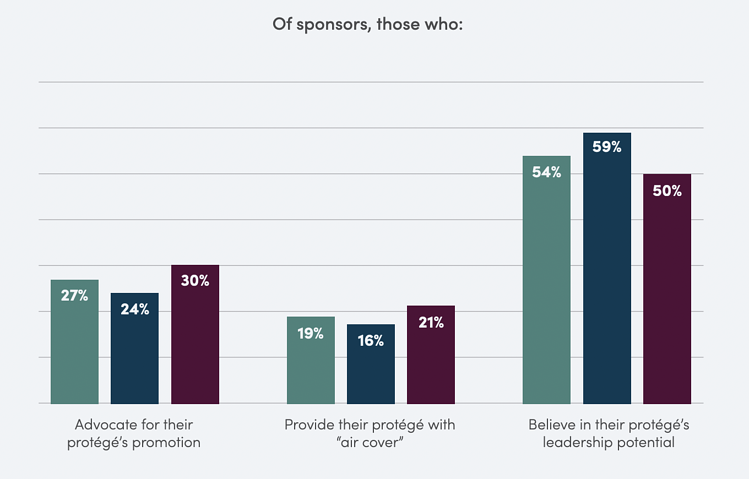
- 27% of sponsors advocate for their protégé’s promotion. (Coqual)
- 54% of sponsors believe in their protégé’s leadership ability. (Coqual)
- 73% of sponsors look for protégé’s who have a proven track record of success and high ability. (Coqual)
- 74% of job seekers and 54% of managers believe mentorship is important for upskilling and reskilling. (Express Employment Professionals)
- 41% of people stated that their mentoring relationship has formal goals. (Olivet Nazarene University)
- Individuals who choose to be a sponsor, mentor, or coach are more likely to reap the benefits of their skills. Most (57%) expand their skill sets (versus 40% or non-sponsors); 41% are more likely to pick up tasks they don’t like to do (versus 26% of non-sponsors); 43% expand their knowledge of their customer base (versus 26% of non-sponsors), and 30% expand their knowledge potential new customers or market segments (versus 19% of non-sponsors). (Coqual)
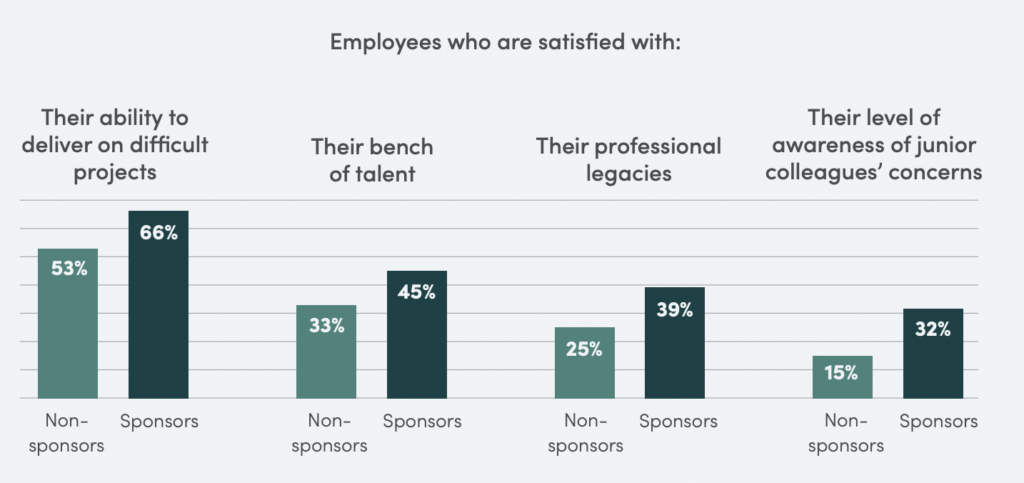
- Leaders who sponsor or mentor others are twice as likely to be aware of junior-level colleagues’ concerns. (Coqual)
- 25% of mentees experienced an increase in their salary, compared to 5% of people not involved in mentoring. (Sun Microsystems)
- Employees involved in mentoring are promoted 5x more often than those not involved in mentoring. (Sun Microsystems)
- Those who serve as a mentor are 6X more likely to be promoted to a higher position. (Sun Microsystems)
- Around 60% of both men and women who serve as sponsors are satisfied with their career advancement. (Coqual)
- 66% of employees who sponsor, coach, or mentor others are satisfied with their ability to deliver on difficult projects. (Coqual)
- In 80% of companies, mentoring is done by non-direct managers (84%), executives/senior managers (83%), and colleagues/peers (80%). (HR.com)
Diversity, Equity, and Inclusion Stats (DEI-Focus)
The majority of the workforce now wants employers who value diversity, equity, and inclusion. In fact, a CNBC/SurveyMonkey survey discovered that 80% of workers want to work for companies that prioritize DEI. And while the data on the benefits of mentoring and its positive impacts on women in the workplace has become far more robust in the past few years, we’ve noticed a significant lack of available data on how mentoring benefits employees who identify as BIPOC or LGBTQ+.
As DEI becomes more important to company culture, more research and data will be needed in the near future to highlight the benefits and gaps in mentoring for many workers within historically underrepresented groups.
Mentorship stats on racial, ethnic, and gender diversity
- 72% of Fair 360’s Top 50 Companies for Diversity have reverse mentoring programs. (Fair 360)
- 73% of men have access to upskilling, compared to 56% of women. (DeVry)
- 37% of women say they have actually used company-sponsored skills training, compared to 56% of men. (DeVry)
- Only 42% of Black, Hispanic, and AAPI employees have access to or have used company-paid upskilling. (DeVry)

- Traditional 1-to-1 mentoring is the most popular type of DEI mentoring program style, according to 38% of workers. That’s followed closely by 31% who most desire 1/1 reverse mentoring. (MentorcliQ)
- Companies that have racially diverse leadership teams are 33% more profitable. (McKinsey)
- 71% of executives choose a protégé that’s their same gender or race. (Coqual)
- 67% of white workers who are satisfied with their career advancement have a mentor, compared to 56% of people of color. (Coqual)
- 69% of women who have a mentor choose one of their same gender, compared to 82% of men. (Olivet Nazarene University)
- 78% of women in senior roles have served as formal mentors at least once in their careers. (DDI)
- 63% of women report that they’ve never had a formal mentor. (DDI)
- 67% of women rate having a mentor as extremely important to their career advancement. (DDI)
- Firms with a larger number of women serving in executive-level positions enjoyed a 6% increase in net profitability. (PIIE)
- Only 54% of women report that they’ve ever been asked to be a mentor in their careers. (DDI)
- 70% of women who mentor other women report that they choose to mentor in order to be supportive of other women. (DDI)
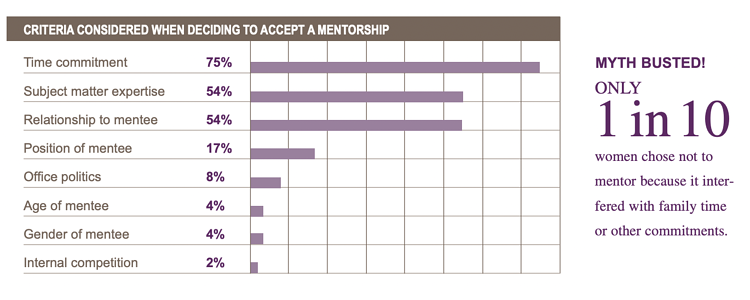
- The biggest considerations for women considering becoming mentors include time commitment (75%), subject matter expertise (54%), and their relationship to the mentee (54%). Most other factors, such as the gender of the mentee (2%) and the age of the mentee (4%) tend not to matter. (DDI)
- 53% of women mentees felt that they didn’t have adequate training to be mentors in a formal mentoring relationship. (DDI)
- Women are 10% more likely to accept a request to be a mentor if their organization has a formal mentoring program. (DDI)
Employee Resource Groups: ERG Stats and Facts

Employee Resource Groups, or ERGs, are now ubiquitous at most medium-sized and enterprise-level businesses. Much like mentoring, ERGs are now seen as a must-have employee engagement strategy. The level of support that ERGs get varies, but emerging trends show that how companies approach ERGs is very similar.
- 100% of Fair 360’s 2023 DiversityInc Top 50 companies have both ERGs and mentoring programs. That’s according to a Diverst analysis into the DNA of companies leading the way in their DEI approach. (Diverst)
- 90% of Fortune 500 companies have ERGs. (McKinsey)
- On average, ERGs have two leaders who dedicate up to 3 hours weekly for management (The Rise Journey)
- The trend of compensating ERG leads is growing; from 6% in 2020 to 42% in 2022, with an average annual compensation just over $2,000. (The Rise Journey)
- 36% of companies on the DiversityInc Top 50 prefer the term “Employee Resource Groups”, while 32% choose “Business Resource Groups.” (Diverst)
- The average number of ERGs at DiversityInc Top 50 companies is around 10, regardless of the company’s size. (Diverst)
- 80% or more of DiversityInc Top 50 companies have ERGs supporting Women, LGBTQIA+, People with Disabilities, Veterans, Black/African American, and Hispanic/Latino demographics. (Diverst)
- Other common but less frequently supported ERGs include Pan-Asian (68%), Multi-Generational (32%), Young Professionals (30%), and Indigenous Americans (30%). (Diverst)
Mentorship Statistics on Millennials and Gen Z
The look of the labor market is changing fast. Alight (formerly NGA Human Resources) predicts that by 2025, 42.5% of the workforce will be Millennials (aged 25-44 during that year) and that 28.2% will be Gen Z (aged 16 to 24). For Millennials, in particular, the coming decade will be critical for future career moves. Consequently, Millennials (and Gen Z) are starting to think more deeply about topics such as skill development, career development, and quality of life.
- 83% of Gen Z workers believe having a workplace mentor is important for their career, yet only 52% report having one. (Adobe)
- 49% of Millennials are looking at quitting their jobs within the next two years. (Deloitte)
- Millennials are more likely to quit because of a lack of career advancement opportunities (35%) and a lack of learning and development opportunities (28%). (Deloitte)
- Gen Z strongly believes in learning, as 76% see learning as critical to their career advancement. (Forbes)
How mentorship helps your next-generation employees

- 68% of millennials who stay at their organization for 5 or more years have a mentor, compared to just 32% of those without a mentor. (Deloitte)
- 82% of Gen Z individuals want supervisors to help them set goals. (Springtide Ressearch Institute).
- 73% of Gen Z are motivated to do a better job when they feel their supervisor cares about them. (SHRM)
- Millennial and Gen Z workers who have a mentor are 21% to 23% more likely to report being satisfied with their current job, compared to those without a mentor. (CNBC/SurveyMonkey)
Do you need help using mentoring statistics to build the case for mentoring at your organization? Book a call today to learn more about how mentoring software can increase employee engagement and retention.
Interested in downloading the 2024 Mentoring Impact Report: Fortune 500 Nears 100% Mentoring Adoption, in its entirety? Let us know, and we will send it to you when it is released on May 1.