As any good HR or talent development leader will tell you, “employee engagement” is often extensive and, as a result, complicated to framework around a single, coherent strategy. Executive leaders press hard for talent development professionals to create metrics-driven employee engagement programs but waver between being too involved in the process or not involved enough. The end result? Everyone’s left wondering what employee engagement really means and how to execute it properly.
Mentoring has, in the past several years, been a go-to strategy. This is exemplified by the quickly increasing adoption rate of mentoring among Fortune 500 companies.
As my colleague Laura Francis and I discussed with the Association of Talent Development (ATD):
- In 2009, 70% of Fortune 500 companies had mentoring programs
- And now, 92% offer mentoring to their employees
That number will likely hit close to 100% within the next few years. Organizational leaders have come to realize that employee engagement is most effective when it’s people-driven and that mentoring is the most people-driven strategy available that can be structured, tracked, measured, and replicated to great success.
As noted already, the entire concept of “employee engagement” is broad and decisively multi-faceted. We’d need to write a few books to capture it completely. Breaking it into focused areas can help HR and talent development leaders create better strategies. In this post, we’ll help you do just that with a detailed guide on what employee engagement means when developed through a mentoring framework.
Employee Engagement, Broadly Defined
At the highest level possible, employee engagement is any strategy talent development and HR leaders use to keep employees interested.
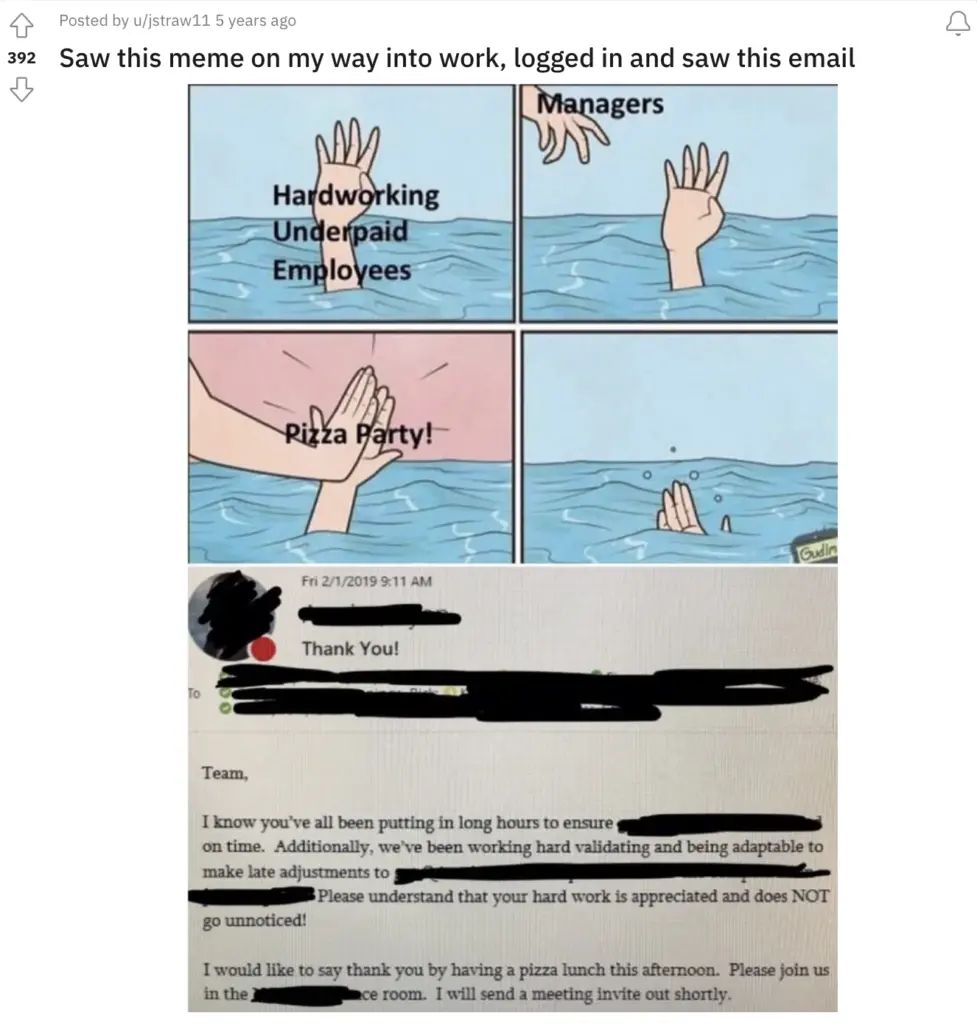
And by any strategy, we mean that literally. Yes, any strategy. That includes the infamous pizza parties that employees (rightfully) love to hate on social media right now. This post on Reddit from /u/jstraw11 just about sums it up.
If you want to apply math to it, employee engagement is a fairly simple equation: effort + thoughtfulness = better engagement outcomes. This is not to say that pizza parties are an inherently bad way to engage employees. In fact, if you throw a dart a calendar, about 13% of Americans would have eaten pizza that day.
But there are far better ways to engage employees that include significantly more effort and far more thoughtfulness, and it starts with understanding why you need to engage employees in the first place.
So, let’s refine that definition of employee engagement a bit.
Employee engagement is any strategy designed to foster a positive work environment where employees feel valued, connected, and motivated to contribute their best efforts toward achieving organizational goals. This involves a multifaceted approach that goes beyond surface-level perks, focusing on meaningful interactions, skill development, and relationship-building activities, This concept is enhanced with data-driven insights to measure and improve engagement over time.
This more specific definition of employee engagement gives you not only what it is but why you need it, and a broad understanding of how you do it.
- What: A strategy to help employees feel connected, valued, and empowered in a way that boosts their contributions toward organizational goals through intrinsic motivation
- Why: Positively impact organizational goals (whatever those may be)
- How: Through meaningful interactions, skill development, and relationship-building opportunities that are built and managed through data insights.
So, more complex than pizza parties? Yes. Don’t dispense with the pizza, though. Just incorporate it into other strategies that are far more meaningful to employees, such as mentoring.
4 Important Building Blocks for Using Mentoring to Engage Employees
I may be dating myself, but as a kid, I loved playing with Lincoln Logs. One thing I learned rather quickly when trying to build a house with them is that A) there was a minimum number of logs I needed to make sure the house could stand up without toppling over (it’s 4), and B) nothing else mattered until I had that foundation built.
That’s true of any house, and it’s true of any employee engagement program, including engagement programs built around mentoring. If you don’t have the foundation secured, you won’t get very far with your program without having it topple.
Before you start building your mentoring-driven employee engagement strategy, there are four areas you need to plan out first. From there, you can really get into the personalization aspect. But without these, your mentoring program strategy won’t hold much weight and won’t survive the critical onslaught that all programs receive eventually.
- Tie your employee engagement strategy to organizational goals: Before initiating any program, understand how it will serve the broader objectives of the organization. This could be in terms of talent development, retention strategies, or fostering a culture of continuous learning.
- Get executive buy-in: Before diving into the details of the mentoring program, secure endorsement and support from the top management. Their buy-in not only provides the necessary resources but also lends credibility to the program, making it easier to engage potential mentors and mentees.
- Develop clear program guidelines and expectations: Create a comprehensive document that outlines the structure, goals, and expectations of the mentoring program. This will act as a roadmap, guiding both mentors and mentees on their journey.
- Set up a robust matching mechanism: Once you have the foundational aspects in place, focus on developing an efficient system to match mentors with mentees. This ensures that both parties have a meaningful and productive relationship.
Note that each of these foundational steps for your mentoring strategy are mostly pre-launch. Once you’re ready for post-launch, make sure to dive into our detailed, 5-step guide on building your program.
Take it with you:
Download your action guide on How to Start a Mentoring Program Right Here.
Tie mentoring programs to organizational goals
Every successful mentoring program starts with aligning the goals of the program to specific and measurable needs of the company. That’s important, not just for the sake of getting better results out of the program. We’ve found time and again, working with HR and talent leaders, that it’s an important first step to getting executive buy-in (which we’ll cover later).
By ensuring that the mentoring program serves a specific purpose that can be easily tied to your company’s bottom line and done so in a way that can be measured against KPIs, you not only add value to the organization but also increase the likelihood of gaining stakeholder support and engagement.
Consider taking the following steps to achieve this:
- Conduct a needs assessment: Begin by identifying the current challenges and gaps within the organization. This could range from skills shortages in certain departments, such as sales, a greater need for leadership development and succession planning, or, more broadly, the need to improve employee retention.
- Engage with key stakeholders: Connect with department heads, team leaders, and other key personnel to gather insights on specific needs and areas of improvement. Their input will be invaluable in shaping the direction of the mentoring program and is a good first step toward finding an executive sponsor who can advocate for your mentoring strategy.
- Set clear objectives: Once you have a grasp of the organization’s needs, establish clear and measurable objectives for the mentoring program. Whether it’s to enhance technical skills, foster leadership qualities, or improve inter-departmental collaboration, having specific goals will give direction to your mentoring initiatives.
- Regularly review and adjust: The business landscape is changing rapidly. Within the span of a few years, we went from a global pandemic to a Great Resignation, to a Great Regret, to a Great Gloom. None of it really feels that “great” from an HR perspective, especially since you need to have an employee engagement strategy in place that is flexible enough to adjust to these trends. Because it’s so inherently people-driven, mentoring is that strategy, but it’s only as good as your review process. Periodically review the alignment of the mentoring program with organizational goals that are being impacted by employee trends. Adjust the program’s objectives as necessary to ensure continued relevance and impact.
When you’ve tied your mentoring program to measurable organizational goals, it can:
- Demonstrate a clear ROI to stakeholders
- Ensures that the program remains relevant and impactful over time
- Increase buy-in from employees and leaders as they see the direct benefits of participation in line with the organization’s vision and culture.
By grounding your mentoring program in the larger objectives of the organization, you lay the foundation for a sustainable and impactful initiative that resonates with both employees and leadership.
Get executive buy-in to guarantee programs get budgeted and supported
Executive buy-in is more than just a stamp of approval, although that’s definitely great to have from a moral standpoint. No employee engagement program can succeed when executives aren’t an active and engaged part of the process.
When you get executive buy-in, you unlock critical commitment and support from your company’s top leaders. Yes, that means unlocking the budget needed for must-have resources like mentoring software and program administrators. But it’s also about visibility with the rest of your company. When senior executives are onboard, it sends a clear message throughout the organization about the importance and value of the mentoring program.
Steps to get executive buy-in:
- Prepare a compelling case: Before approaching executives, arm yourself with mentoring stats, data and insights. Highlight the benefits of mentoring, potential ROI, and how it aligns with organizational goals. Use case studies or examples from similar organizations to bolster your argument.
- Highlight long-term benefits: While short-term gains are appealing, executives are often more interested in the long-term impact. Emphasize how the mentoring program can aid in talent retention, leadership development, and building a future-ready workforce.
- Showcase a pilot or trial: If possible, run a small-scale pilot of the mentoring program. Gather feedback and results to present to executives, demonstrating the program’s potential effectiveness. Note that this is not the preferred route. Manually running mentoring programs is challenging, and you may not get great results. But if you can prove success on a small scale, you can help make the argument for mentoring at scale as a beneficial approach to employee engagement.
- Address potential concerns: Be prepared for skepticism or concerns from leadership. We see it all the time, even from executives who already believe mentoring is a great engagement strategy. Whether it’s about resource allocation, potential challenges, or program scalability, have answers ready to alleviate these concerns.
With the endorsement of top leadership, you can expect to see great results, such as:
- The program gains credibility and legitimacy in the eyes of potential mentors and mentees
- Securing resources, whether it’s budget or tools, becomes more straightforward
- The overall success rate of the program increases as it gets integrated into the organization’s strategic initiatives
As a good friend of mine would say, “It’s as great as chocolate cake!” Gaining the support of senior executives is not just paramount; it’s necessary to really build the employee engagement strategy you know you need. Their endorsement not only facilitates the smooth rollout of the mentoring program but also ensures its longevity and success within the organization.
Develop clear program guidelines and expectations
Establishing well-defined guidelines and expectations sets the tone for the entire mentoring program. It ensures consistency, transparency, and clarity for all participants, reducing potential misunderstandings and ensuring that everyone is on the same page.
It’s also an important ingredient in convincing executive leaders that mentoring is important and aligned with the employee engagement needs they have in mind. Show them what mentoring is capable of and that social learning can be structured, measurable, and replicable.
Steps to developing clear program guidelines:
- Define roles and responsibilities: Clearly outline what is expected of both mentors and mentees. This might include meeting frequencies, confidentiality and mentoring agreements, goal-setting processes, and feedback mechanisms.
- Establish a code of conduct: Develop a set of behavioral guidelines that promote a respectful and productive mentoring relationship. Address potential issues such as conflicts of interest, communication boundaries, and the importance of mutual respect. Additionally, tie all of this back to your existing company culture (or the culture that you’re trying to create).
- Provide resources and support: Offer tools, resources, and training materials that can aid both mentors and mentees in their journey. This could include articles, webinars, workshops, or even access to a dedicated support person or team. Since you may be building out the program for the first time before getting executive approval, much of this could be proposed resources and tools. And if you need help creating those, we’re more than happy to help.
- Set up evaluation metrics: Determine how you’ll measure the success of the mentoring program. Whether it’s through feedback surveys, success stories, retention data, internal movement (such as promotions), or tracking progress toward goals, having clear metrics will help in assessing and refining the program over time.
With well-defined guidelines in place, you can expect to see the following happen:
- Participants have a clear roadmap, reducing uncertainty and apprehension.
- Potential disputes or misunderstandings can be mitigated or resolved more efficiently.
- The program maintains a consistent standard, ensuring a quality experience for all involved.
- It becomes easier to onboard new participants, as there’s a structured framework to guide them.
Clear guidelines act as the backbone of the mentoring program, providing structure and direction while ensuring a smooth and beneficial experience for all participants.
Set up a robust matching mechanism
One of my favorite musicals is Fiddler on the Roof — (which I’ve seen live performances of twice now) — with its timeless and classic songs, especially “Matchmaker, Matchmaker.” I think of it almost every time anyone at MentorcliQ or our customers talks about matching. And indeed, we talk about matching quite often because it’s easily the most important piece of the mentoring puzzle.
The success of a mentoring relationship often hinges on the compatibility of the mentor and mentee. A robust matching mechanism ensures that pairs are aligned in terms of skills, experiences, goals, and personalities, leading to more fruitful and impactful mentoring interactions.
Steps to get mentor-mentee matches that lead directly to positive results include:
- Gather detailed profiles: Collect comprehensive information from both potential mentors and mentees. This could include their professional background, skills, areas of expertise, learning objectives, and even personal interests or preferences. With MentorcliQ’s software, this can be automated upon participant enrollment and only a few minutes. That increases participation rates and hastens matching.
- Utilize technology: Consider employing a scientific-based approach to matching (as opposed to manual matching). MentorcliQ’s technology leans on industry-leading technology built around the logic of the Nobel Prize-winning stable matching algorithm to find the best matches based on the collected data. Such algorithms can analyze multiple data points to suggest highly compatible pairs. Moreover, the larger the dataset, the better these algorithms work, making the software ideal for enterprise businesses.
- Allow for human intervention: While technology can provide suggestions, and MentorcliQ’s tool can even automate the matching process from start to finish with minimal administrative input, there’s value in allowing for human judgment. A program administrator can review matches and match scores that the algorithm provides to ensure there’s a good fit, especially in more nuanced or complex scenarios.
- Facilitate initial meetings: Once pairs are matched, organize introductory sessions. These meetings allow mentors and mentees to get acquainted, set expectations, and determine if they feel the match will be beneficial.
- Provide an option to rematch: Even when technology is at its best, matches at times don’t work out for various reasons. Offer an avenue for either party to request a re-match if they feel the relationship isn’t right for their needs right now.
With a strong matching system in place, you can see some incredible benefits:
- Retention for both mentors and mentees increases by 50% compared to non-participants
- Mentoring relationships are more likely to be successful and long-lasting
- Both mentors and mentees feel more satisfied as they see tangible progress and benefits
- The overall efficacy and reputation of the mentoring program are enhanced
- Potential frustrations or mismatches are minimized, leading to higher program retention rates
Ensuring that mentors and mentees are well-matched is a pivotal component of any mentoring initiative. It sets the stage for meaningful interactions, growth, and development for both parties involved.
Take Employee Engagement to the Next Step
I like pizza as much as the next person, but pizza won’t grow my skills or provide sustained personal and professional development. It might serve as a one-off for networking, but it a slice of pizza won’t sponsor me when it’s time to start looking for leadership positions within my company. Few employee engagement programs will do all of that. Mentoring, however, will help achieve those ends and much more.
By tying your engagement strategy to organizational goals, securing executive buy-in, developing clear guidelines, and implementing a robust matching mechanism, you lay the groundwork for an employee engagement strategy that resonates with employees at all levels. Such a program not only facilitates skill development and knowledge sharing but also fosters a culture of continuous learning and collaboration.
But remember, launching a mentoring program is just the beginning. Connect with us today to learn how to create, grow, and sustain mentoring programs the same way industry leaders like Disney, Wendy’s, Sony, and Nielsen are doing right now.